What the Boards Carry: Solid Timber and the British Floor
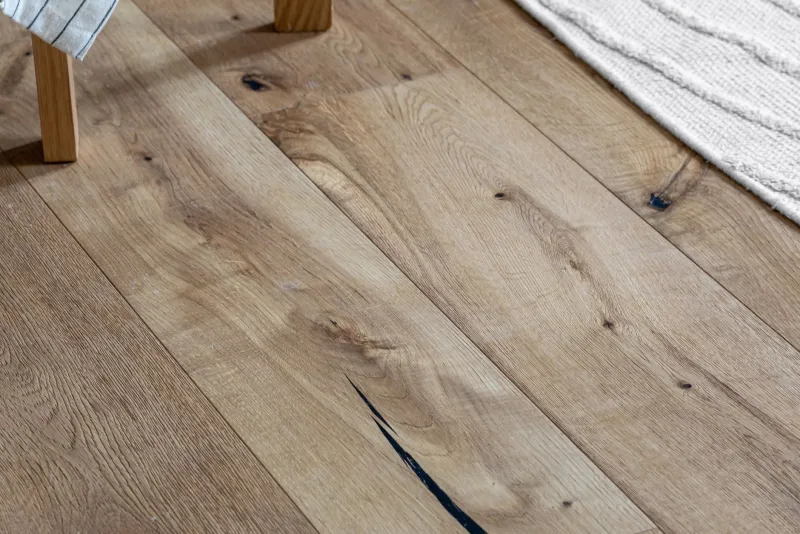
The floor is the first surface a room asks the body to trust. It is also, too often, the last specification to be examined. In 2026 the British interior is subject to unusually close scrutiny: kitchen surfaces are debated by material, joinery is drawn at full size, lighting is modelled before it is bought. Yet the floor frequently arrives as a sample chip, a colour name and a price per square metre. That is a thin basis for a surface that will carry every step, every chair leg and every accident of domestic life for decades.
The default and its discontents
Engineered oak has earned its dominance. It is dimensionally stable, familiar to fitters, compatible with underfloor heating and widely available in convincing formats. But the default has become so complete that it has obscured a distinction the British home now needs to recover: the difference between a floor that is merely laid and a floor that can be maintained. Many engineered boards carry a wear layer of three or four millimetres. That is enough for one or two careful sandings, after which the board is spent. A solid timber board of eighteen or twenty-two millimetres can be refinished repeatedly, repaired locally and, in the right circumstances, lifted and relaid. Repairability is not nostalgia. It is a specification principle.
Format is an architectural decision
Board format does more to a room than most clients expect. Narrow strips produce a busier, more rhythmic surface; wide boards calm a space and reduce the number of joints underfoot. In British rooms, where floor areas are often modest and doorways interrupt the run, width must be judged against the plan rather than the sample. A 240mm board in a small spare room can feel generous; the same board in a long, low living room can read as a single field of timber. Thickness matters too. Twenty millimetres and above gives a solid floor its acoustic weight and its capacity for future sanding. Length, grading and the direction of the run all affect how the room is read. So does the junction: skirting, threshold, reveal. These are architectural decisions disguised as flooring choices.
Species, source and the question of provenance
Britain has a limited but meaningful supply of hardwood. Oak is the obvious choice; ash, elm and sweet chestnut have their own grain and movement. Reclaimed stock from schools, warehouses and mills can bring a density and character that new timber rarely matches, though it demands patience and a willingness to accept knots, sapwood and old nail holes as part of the specification. Provenance should be written down, not assumed. Certification, UK Timber Regulations compliance and a clear chain from mill to site are reasonable requests in 2026. Moisture content matters as much as species. A board acclimatised to a British interior will move less unpredictably than one rushed from a container into a heated room.
Finish, repair and the long view
Finish is where solid timber justifies itself most clearly. A hardwax oil or penetrating oil leaves the grain open, allows spot repair and acquires a patina that reads as use rather than damage. A lacquer can offer a more uniform surface, but it films the board and shows wear as a change in sheen. Neither is universally correct. What matters is that the finish is specified alongside a maintenance regime: the cleaning products, the re-oiling interval, the name of the contractor who will sand it in ten years. A floor without a repair plan is only a floor until its first serious scratch.
Acoustic behaviour and the British flat
Solid timber has an acoustic signature that engineered boards do not always reproduce. On battens or a direct fix, it can sound warmer and more grounded underfoot, but in flats and conversions the structure matters more than the surface. Part E requirements, acoustic underlays and separation details must be resolved before the boards are ordered. In a house, the floor is part of the room's quiet; in a flat, it is part of the building's peace. The specification should say which is being designed.
Underfoot, but not overlooked
Solid timber is not a universal answer. It requires sensible humidity, careful detailing and a fitter who understands movement. It is less forgiving of haste than a click system. Yet the British interior in 2026 has become attentive to materials that age well, and the floor is overdue for the same attention. Ask for the thickness, the source, the finish and the plan for repair. Ask what the boards will carry. A floor that remembers is not a sentimental idea; it is a specification with consequences.