The Unperformed Home: Britain’s Quiet Interiors in 2026

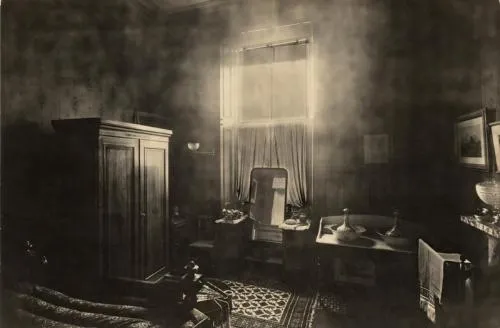
Photo: Joseph Mischyshyn, CC BY-SA 2.0, via Wikimedia Commons
In 2026, the most design-literate homes in Britain are not always the most photographed. Walk into a certain kind of contemporary interior — a Bristol terrace, a Glasgow tenement flat, a Victorian semi in Leeds — and you may find no statement island, no colour-matched bookshelf, no arrangement of objects placed for the camera. Instead there is a worn oak table, a lamp that throws light unevenly across lime plaster, a wool throw with a pulled thread, a stack of paperbacks that has grown organically rather than by curation. These are the quiet rooms: spaces designed for living rather than sharing.
The retreat from performative domesticity
Talk to designers working outside the capital and the same phrase recurs: the staged home has lost its authority. The shift is not a rejection of design, but a recalibration of what design is for. After years in which the domestic interior was treated as a backdrop for social media — every surface resolved, every object auditioned — there is a growing appetite for rooms that admit mess, habit and change.
Maya Ellison, an architect in Bristol, describes a change in client briefs over the past three years. “People still care about proportion and light,” she says, “but they are less interested in a room that reads well in a single image. They ask how a surface will age, whether a chair can be repaired, where the dog will sleep.” That practical turn has design consequences. Storage becomes less about concealment and more about ease of use; lighting becomes layered and forgiving; finishes are chosen for how they wear rather than how they photograph on the day of completion.
In Glasgow, the stylist Isla Menzies has noticed a similar fatigue. “There is a weariness with the idea that every corner must be resolved,” she says. “The most interesting rooms now are allowed to remain slightly incomplete. A shelf is half-filled. A chair does not match. Someone’s coat is on the back of it.” This is not an argument for disorder. It is an argument for evidence of life.
Texture, patina and the ordinary
The aesthetic — if it can be called that — is less a look than a set of priorities. Lime plaster instead of flat emulsion. Unsealed brass instead of lacquered hardware. Beeswax on timber, wool underfoot, linen at the window, cork and quarry tile where a harder surface is needed. These materials do not offer the frictionless finish of the show home. They mark, soften and darken. In return, they develop a patina that reads as history rather than damage.
Patina is not a finish. It is a record. A kitchen worktop that has been oiled annually will show the rings of countless mugs; a stone floor will acquire a route between door and sink. For a generation of homeowners weary of surfaces that must be protected from use, this is a relief. The beauty of the everyday lies precisely in objects that are allowed to be ordinary: a good wooden spoon, a sturdy glass, a lamp with a frayed flex that has been rewired rather than replaced.
This is where the “unphotogenic” comes in. The quiet interior often depends on elements that resist the camera: a drying rack, a boiler cupboard, a chair that is comfortable but slightly shapeless. Design-literate homeowners are increasingly willing to accommodate these things rather than design them out. The result can look unresolved in a photograph and feel entirely right in person.
A regional reading
Quiet interiors are not uniform. Housing stock shapes the mood. In Bristol, the combination of Victorian terraces and postwar infill encourages a pragmatic approach: modest rooms, good daylight, a preference for built-in joinery that does not shout. In Glasgow, tenement flats bring high ceilings, deep window reveals and a tradition of robust materials; the quiet interior here often means repairing rather than replacing, and allowing the architecture to do more of the work.
In Sheffield, homeowners speak of a similar instinct shaped by the city’s making culture. There is less patience with finishes that cannot be maintained locally and more interest in pieces that can be mended by the person who made them. In Leeds, the conversation turns on warmth: how to make a large Victorian room feel settled without filling it with clutter. The answers tend to be tactile rather than visual — a heavy curtain, a rug with some weight, a sofa that has been reupholstered rather than discarded.
The practical argument
Quiet interiors are often cheaper than their staged counterparts, though not because they are careless. They rely on fewer, better things, and on a willingness to live with what is already there. Painting a room in a single breathable colour is less expensive than panelling it. Repairing a table is less expensive than replacing it. Buying one well-made lamp instead of four fashionable ones is a saving as well as a restraint.
There is an environmental logic, too. The most sustainable interior is usually the one that has not been ripped out. Designers working in this vein speak of maintenance as a design principle: accessible services, repairable joints, finishes that can be spot-treated rather than replaced. The quiet room is not a passive room. It is a room that has been thought through.
The risk of another aesthetic
There is a risk, of course, that quietness becomes another style — a new performance of authenticity, complete with artfully distressed plaster and carefully sourced “imperfect” ceramics. The point is not to fetishise shabbiness or to turn patina into a luxury finish. A room can be quiet and precise. A room can be unphotogenic and still be badly planned.
The distinction lies in intent. A quiet interior is one in which the design serves the life within it, rather than the other way round. It accepts that a home is a working environment as well as a visual one. It allows for the beauty of the everyday without insisting that the everyday be beautiful at all times.
In 2026, that may be the most design-literate position of all: to make a room that does not need to be looked at in order to be understood.